


A practical guide for Indian organizations to move from awareness to audit-ready privacy and cybersecurity compliance.
Every organization today collects, stores and shares personal data: customer contact details, employee records, vendor information, website visitor data and more. With the Digital Personal Data Protection (DPDP) Act, 2023, India now has a comprehensive law governing how that digital personal data must be handled.
For MSMEs, startups, IT companies, healthcare providers, financial institutions, e-commerce businesses, educational institutes and service providers, compliance is no longer optional. It is a business necessity.
The challenge is that most organizations do not know where to begin. Some jump straight to writing a privacy policy. Others commission a security audit and assume the job is done. Neither approach works on its own.
"For implementing data protection compliance requirements such as India's Digital Personal Data Protection (DPDP) Act, 2023, SecureClaw follows a structured lifecycle approach organized into seven clear stages: Discover, Classify, Assess, Analyze, Implement, Prepare, and Monitor."
Dr. Shekhar A Pawar CEO, SecureClaw
This article walks through each stage, what it involves, and what your organization receives at the end of it.
Table of Contents
Is Your Organization Ready for India's Data Privacy Era?
Understanding the DPDP Act 2023 in Brief
The SecureClaw 7-Stage DPDP Compliance Model
Stage 1: Discover (Data Identification and Mapping)
Stage 2: Classify (Data Classification and Ownership)
Stage 3: Assess (Privacy, Security and Vendor Risk Assessments)
Stage 4: Analyze (Gap Analysis and Reporting)
Stage 5: Implement (Policies, Controls and Consent Management)
Stage 6: Prepare (Training and Breach Readiness)
Stage 7: Monitor (Audit, Reporting and Continuous Compliance)
Start Your DPDP Compliance Journey Today
Understanding the DPDP Act 2023 in Brief
The DPDP Act, 2023 establishes rules for the collection, processing, storage, protection and sharing of digital personal data. It creates two key roles:
- Data Principals: the individuals whose personal data is collected (customers, employees, vendors, website visitors).
- Data Fiduciaries: the organizations that decide why and how that data is processed.
The Act grants rights to Data Principals and places clear responsibilities on Data Fiduciaries. It may apply to your organization if you:
- Collect personal data digitally
- Process customer information
- Manage employee records
- Operate websites, mobile applications or online platforms
- Store personal information in databases, cloud systems, emails or internal applications
- Use third-party service providers for data processing
Whether your organization has 10 employees or 10,000, the Act may apply to your operations.
Why Compliance Matters?
- Avoid Regulatory Penalties: The Act empowers authorities to impose significant financial penalties for failure to protect personal data, inadequate security safeguards, failure to notify a breach, and mishandling of consent and individual rights requests. Penalties under the Act can run into hundreds of crores of rupees.
- Build Customer Trust: Customers increasingly prefer organizations that are transparent and accountable about privacy.
- Protect Business Reputation: A single breach can bring negative publicity, legal disputes, business disruption and financial loss.
Privacy Compliance Is Also a Cybersecurity Requirement
Many organizations treat DPDP compliance as a purely legal exercise. In reality, it needs two kinds of controls working together:
| Administrative Controls | Technical Controls |
|---|---|
| Privacy and Data Protection Policies | Vulnerability Assessment and Penetration Testing (VAPT) |
| Consent Management Procedures | Secure application development and SAST |
| Vendor Management Processes | Multi-Factor Authentication (MFA) |
| Data Retention Policies | Encryption and access control |
| Employee Awareness Training | Endpoint protection and security monitoring |
| Incident Response Plans | Backup, recovery and Data Loss Prevention (DLP) |
Without cybersecurity controls, privacy compliance remains incomplete. This is exactly where SecureClaw's integrated approach makes the difference.
The SecureClaw 7-Stage DPDP Compliance Model
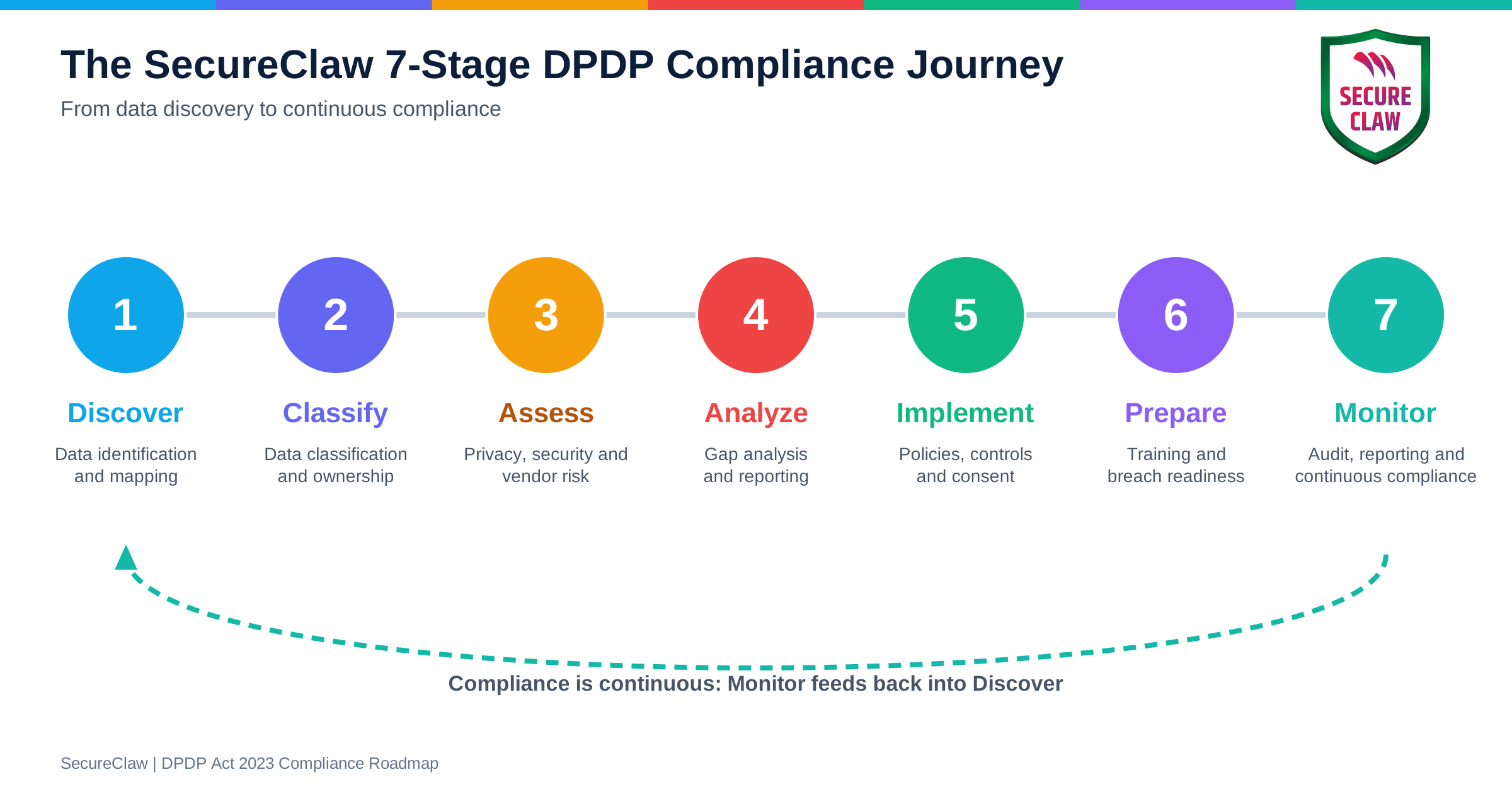
| Stage | Focus | Key Outcome |
|---|---|---|
| 1. Discover | Data identification and mapping | Data Inventory and Data Flow Maps |
| 2. Classify | Data classification and ownership | Classification Framework and Ownership Matrix |
| 3. Assess | Privacy, security and vendor risk | Risk Registers and Security Reports |
| 4. Analyze | Gap analysis and reporting | Gap Report and Remediation Roadmap |
| 5. Implement | Policies, controls and consent | Policy Framework and Consent System |
| 6. Prepare | Training and breach readiness | Training Records and Incident Playbook |
| 7. Monitor | Audit, reporting and continuous compliance | Dashboard, Audit Report and Annual Review |
Stage 1: Discover (Data Identification and Mapping)
You cannot protect what you do not know you have.
Many organizations cannot answer basic questions: What personal data do we collect? Where is it stored? Who can access it? How long do we keep it? The Discover stage answers all of them.
What we do?
- 1. Define scope: Identify business units, departments, applications, vendors, websites, portals and mobile apps that process personal data.
- 2. Identify personal data assets: Catalogue customer data, employee data, vendor data, website visitor data, applicant and HR data, and marketing databases.
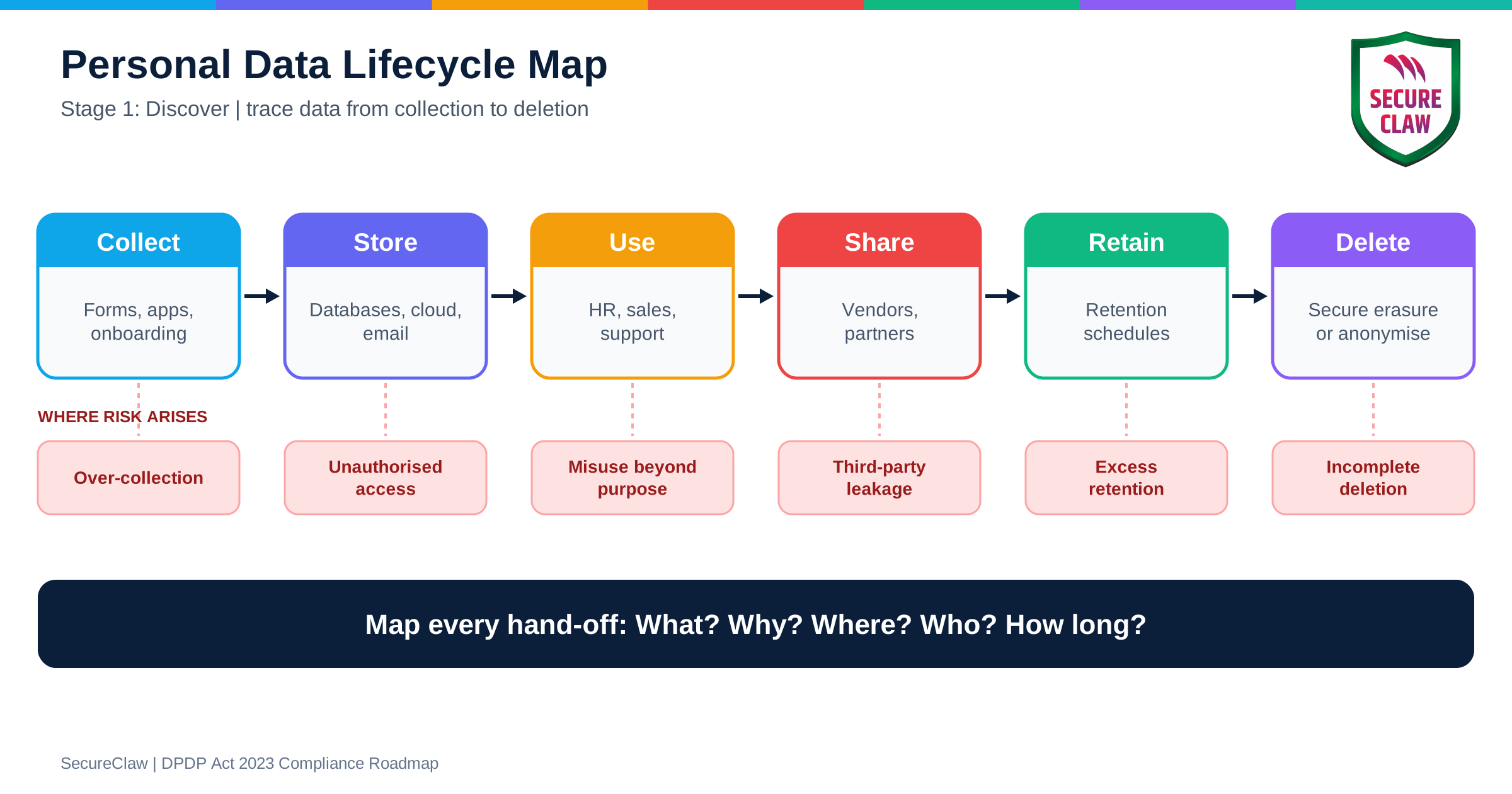
- 3. Discover and map data: For each data set, determine what is collected, why, where it is stored, who accesses it, who receives it and how long it is retained. We then trace the flow from collection to deletion.
Examples of personal data we map
- 1. Customer data: names, contact details, email addresses, mobile numbers, location and financial information.
- 2. Employee data: HR records, payroll, identification documents, background verification and attendance systems.
- 3. Vendor and partner data: contact information, contract records and business information.
Deliverables
- Compliance Scope Document and Stakeholder Register
- Personal Data Inventory
- Data Flow Diagrams
- Data Mapping Register
Stage 2: Classify (Data Classification and Ownership)
Not all data carries the same risk. Treat it accordingly.
Once you know what data you hold, the next step is to organize it by sensitivity and assign clear accountability.
Data Classification
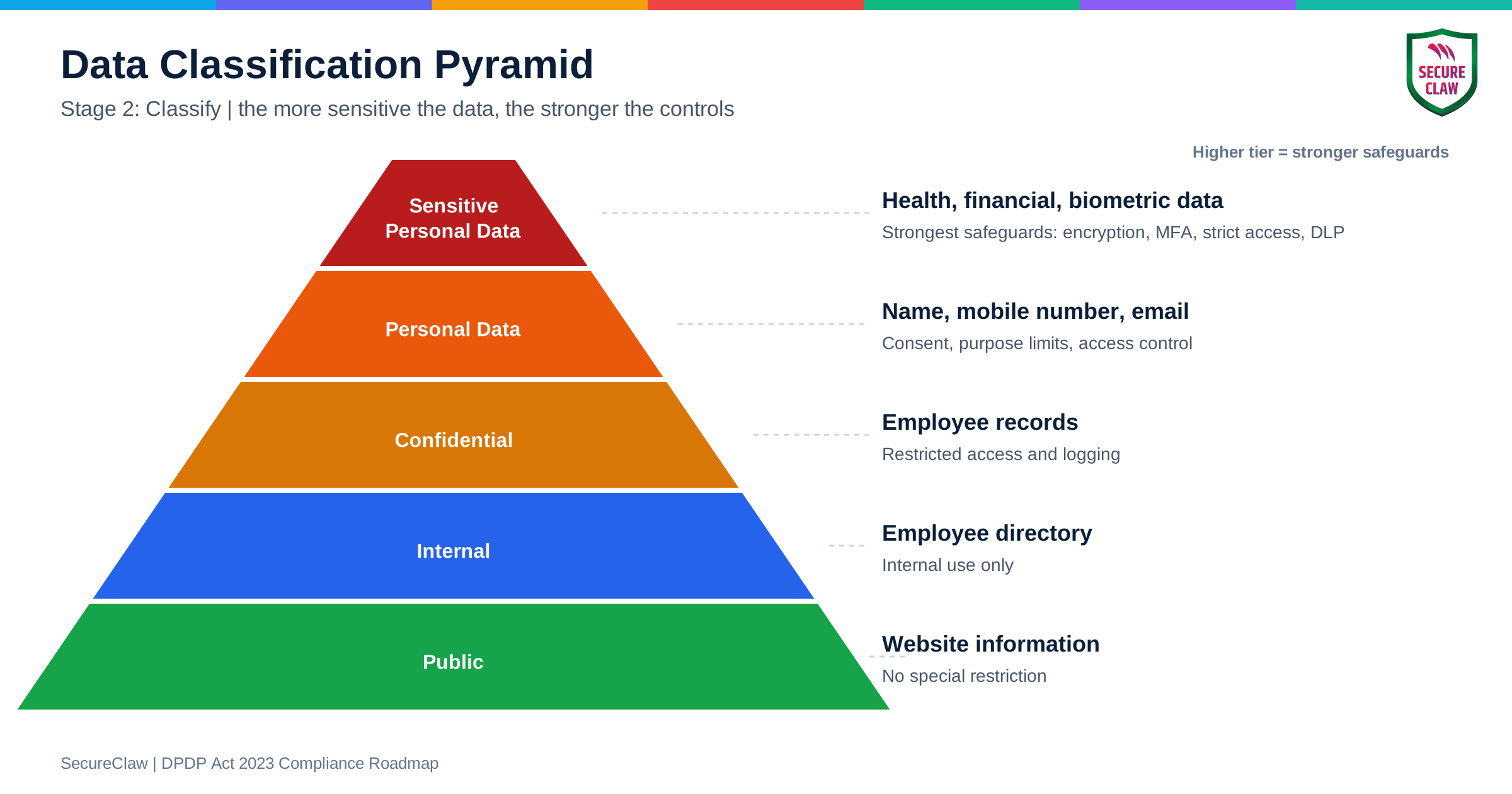
We classify information into levels so that stronger controls protect more sensitive data:
| Level | Examples |
|---|---|
| Public | Website information |
| Internal | Employee directory |
| Confidential | Employee records |
| Personal Data | Name, mobile number, email |
| Sensitive Personal Data (good practice) | Health, financial and biometric data |
The DPDP Act does not create a separate legal category for sensitive personal data, but treating health, financial and biometric data with extra care is a recognized good practice and reduces breach impact.
Data ownership
- HR Head: Employee Data Owner
- Sales Head: Customer Data Owner
- IT Team: Data Custodian
Clear ownership removes the "everyone's responsibility, so no one's responsibility" problem that causes many compliance failures.
Deliverables
- Data Classification Framework
- Data Ownership Matrix
Stage 3: Assess (Privacy, Security and Vendor Risk Assessments)
Find the risks before an attacker or an auditor does.
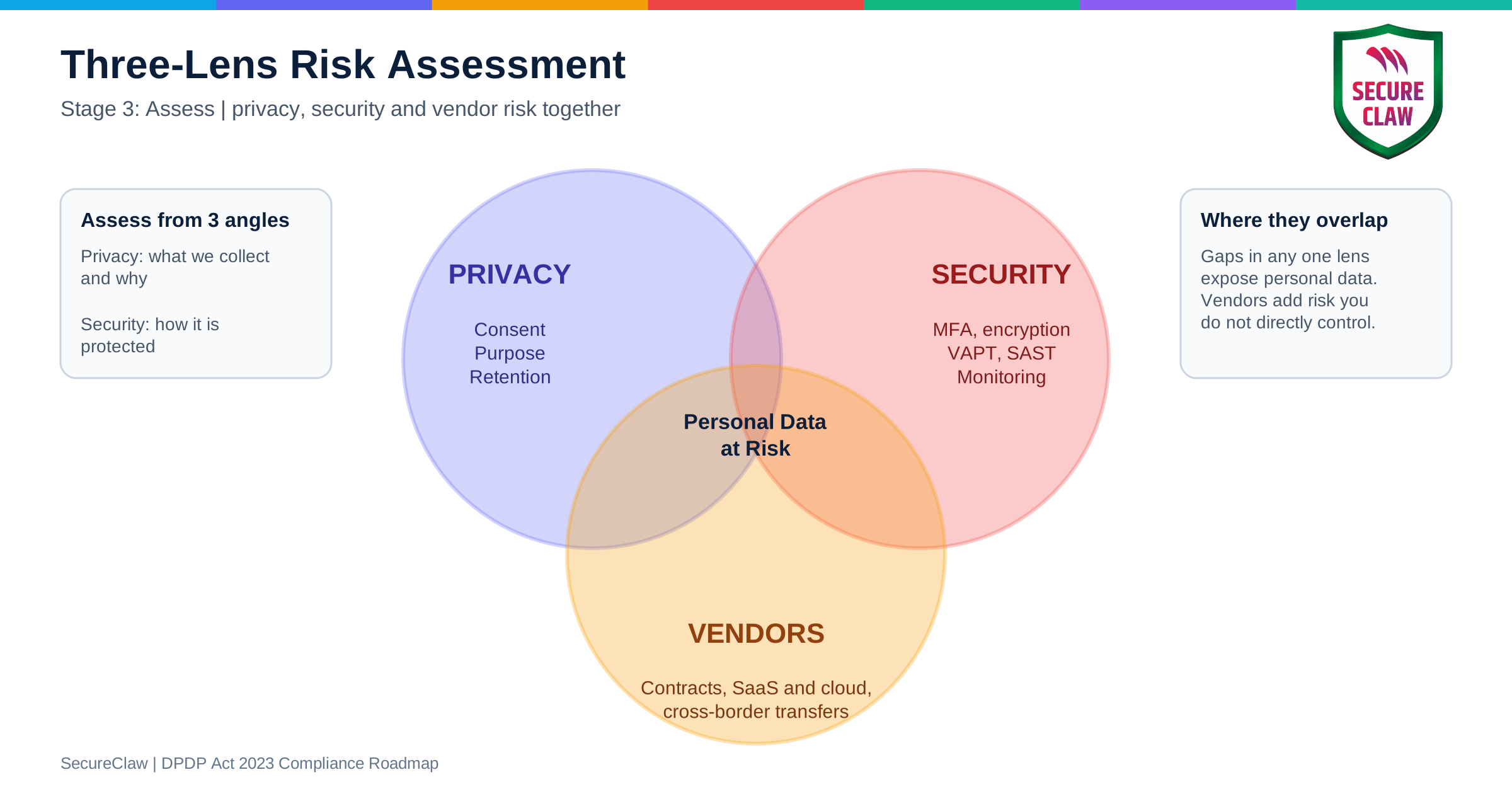
This stage looks at your organization from three angles: privacy, cybersecurity and third parties.
3.1 Privacy Assessment
- Purpose of Processing: For every data element: why is it collected, is it necessary, and can collection be minimized?
- Consent and Notice Review: We examine website forms, mobile apps, employee onboarding forms and marketing subscriptions to confirm that consent is obtained, recorded and can be withdrawn.
- Process Analysis: We review customer onboarding, hiring, payroll, marketing campaigns and support operations for excessive collection, unauthorized sharing, missing approvals and privacy risks.
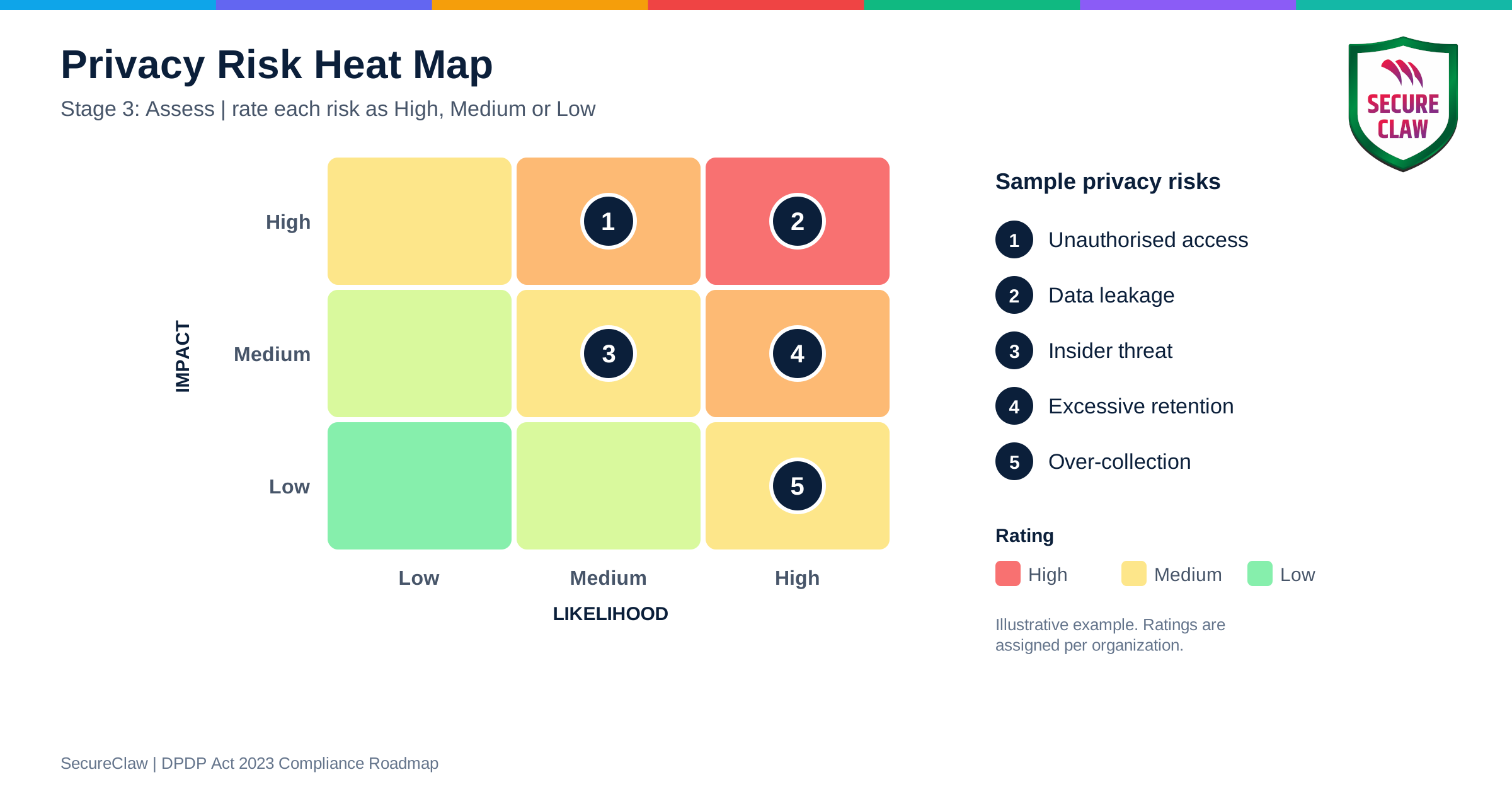
- Privacy Risk Assessment: Risks such as unauthorized access, data leakage, insider threats, excessive retention and over-collection are identified and rated High, Medium or Low.
3.2 Security Assessment
Personal data protection depends on strong cybersecurity. SecureClaw reviews:
- Access control, MFA and password policies
- Encryption, logging and monitoring
- VAPT across web applications, internal networks, external infrastructure, APIs and cloud environments
- Secure development practices, including source code review, SDLC controls, SAST and DAST
- Configuration reviews of firewalls, cloud environments and access controls
3.3 Vendor and third-party risk assessment
Your vendors may process personal data on your behalf, and your organization remains accountable for it. We evaluate cloud providers, IT vendors, HR and payroll providers, SaaS platforms, CRM providers and managed service providers, verifying contracts, security controls and data processing obligations.
We also run a cross-border data transfer assessment to establish whether data is stored outside India, which cloud providers are used, and whether international transfers occur.
- Consent Assessment Report and Process Risk Assessment
- Privacy Risk Register
- Security Assessment Report, VAPT Report and Remediation Plan
- Application Security Report
- Vendor Risk Register
- Cross-Border Data Transfer Register
Stage 4: Analyze (Gap Analysis and Reporting)
Know exactly where you stand against the law.
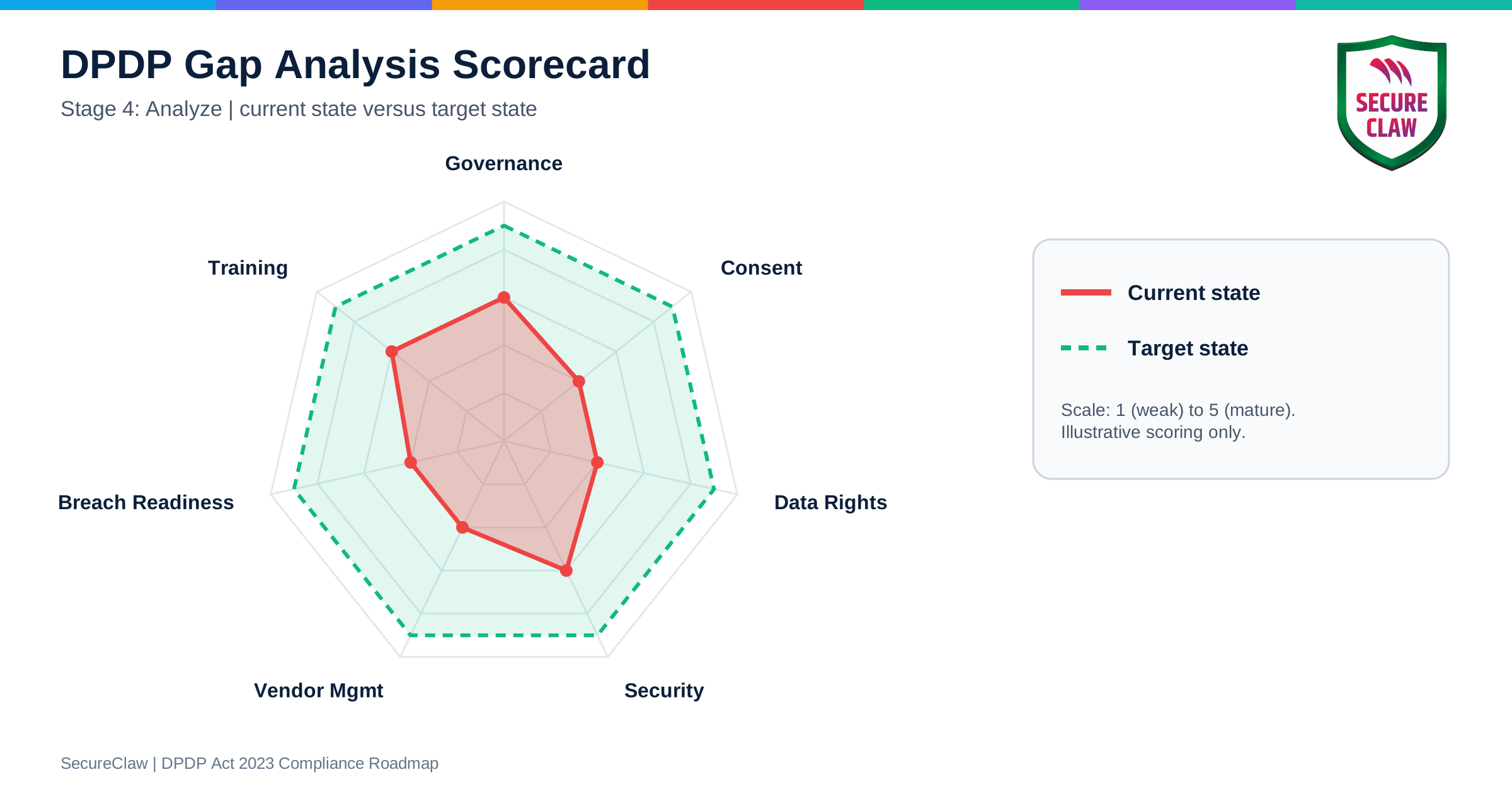
With discovery, classification and assessment complete, we compare your current state against the requirements of the DPDP Act 2023, the DPDP Rules as notified, and your own organizational requirements.
What we identify
- Policy Gaps: missing or outdated privacy documentation
- Technical Gaps: weak or absent security controls
- Operational Gaps:: processes that do not support consent, rights requests or breach handling
- Documentation Deficiencies: records you would need to demonstrate compliance
Each gap is prioritized by risk and effort, so leadership can see what to fix first and what it will take.
Deliverables
- DPDP Gap Assessment Report
- Detailed Compliance Gap Report
- Prioritized Remediation Roadmap
Stage 5: Implement (Policies, Controls and Consent Management)
Turn findings into working safeguards.
This is where the remediation roadmap becomes reality. Implementation has four parts.
5.1 Policies and procedures
- Privacy Policy and Data Protection Policy
- Data Retention Policy
- Consent Management Procedure
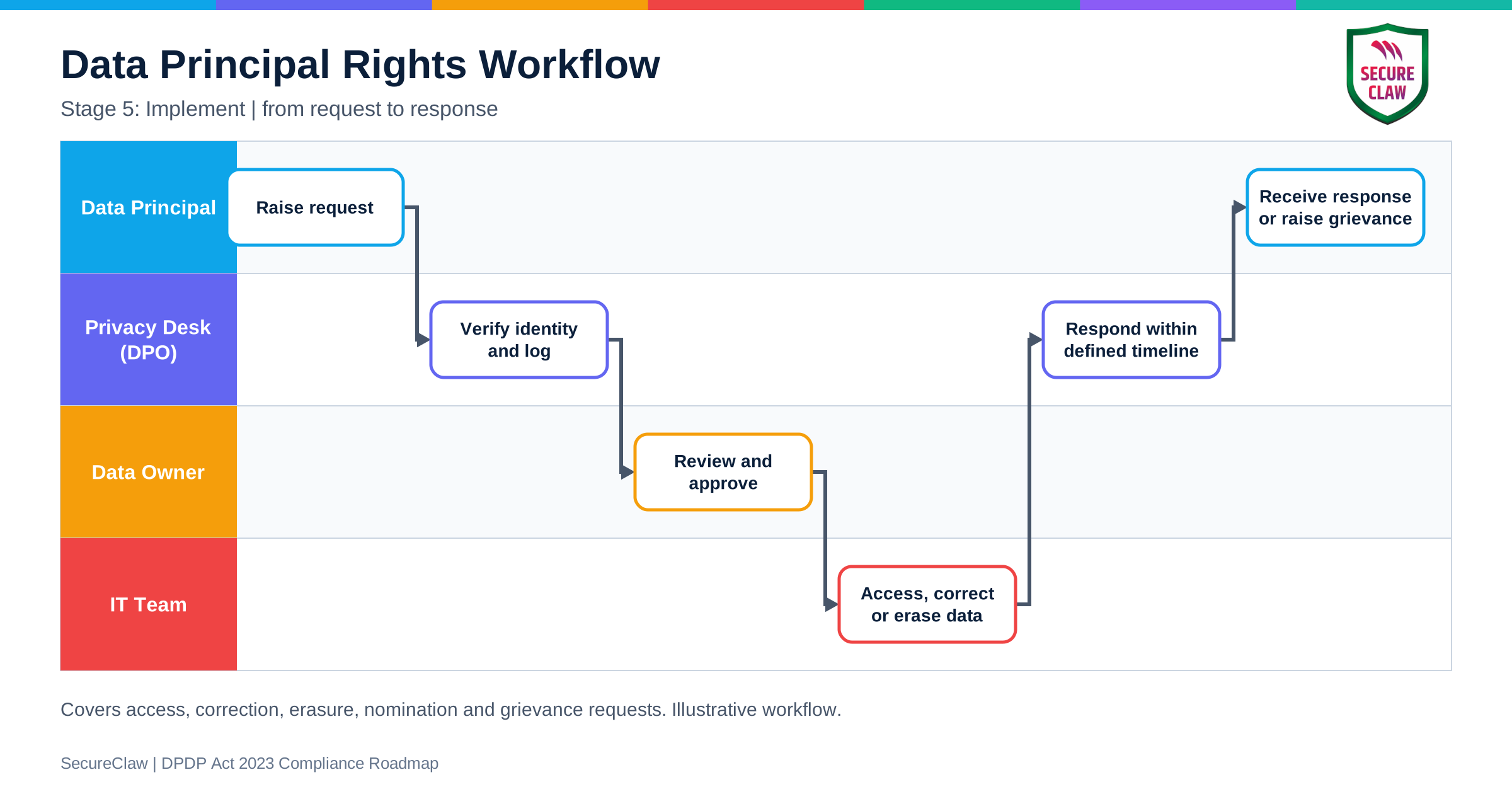
- Data Principal Rights Procedure
- Grievance Redressal Procedure
- Breach Response and Notification Procedure
- Employee Data Protection Policy
Each gap is prioritized by risk and effort, so leadership can see what to fix first and what it will take.
5.2 Technical controls
- Multi-Factor Authentication and access management
- Encryption of data at rest and in transit
- Data Loss Prevention (DLP)
- Endpoint security
- Backup and recovery controls
- SIEM-based security monitoring
5.3 Consent management framework
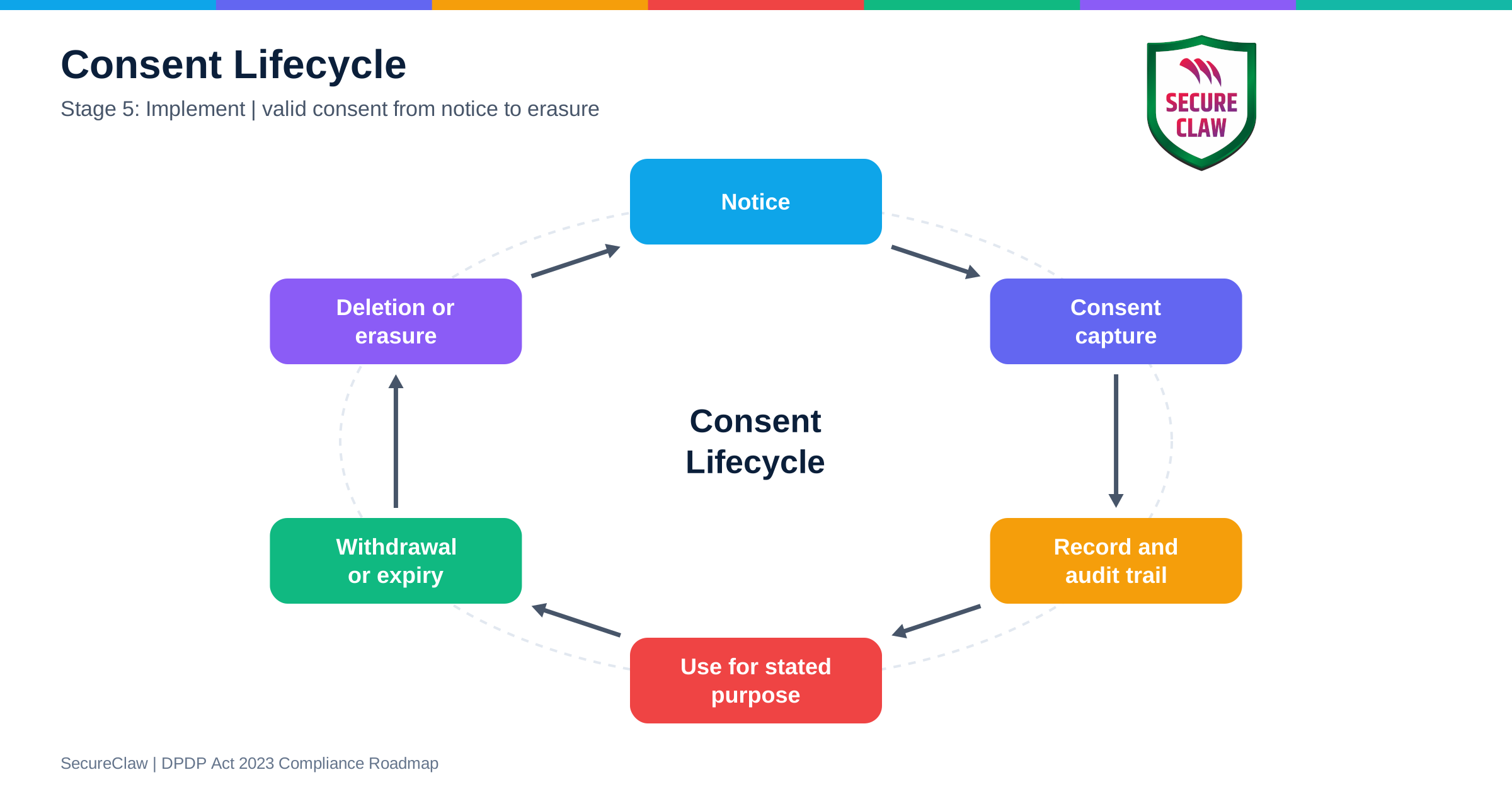
Valid consent sits at the heart of the Act. We help you put in place:
- Clear privacy notices on websites, apps and forms
- Consent capture mechanisms and consent records
- Easy consent withdrawal
- An audit trail proving who consented to what, and when
5.4 Data Principal rights process
Individuals can ask you to give access to their data, correct it, erase it, nominate someone to exercise rights on their behalf, and raise grievances. We design a workable process so your team can handle these requests accurately and on time.
Deliverables
- Compliance Documentation Package and Policy Framework
- Security Control Register
- Consent Management Framework or Platform
- Data Rights Handling Procedure
Stage 6: Prepare (Training and Breach Readiness)
People and preparation decide how bad an incident becomes.
Human error remains one of the leading causes of data breaches, and no organization can guarantee it will never be attacked. What you can control is how ready you are.
Management awareness for leadership, covering accountability, risk exposure, penalties and governance
Breach Readiness
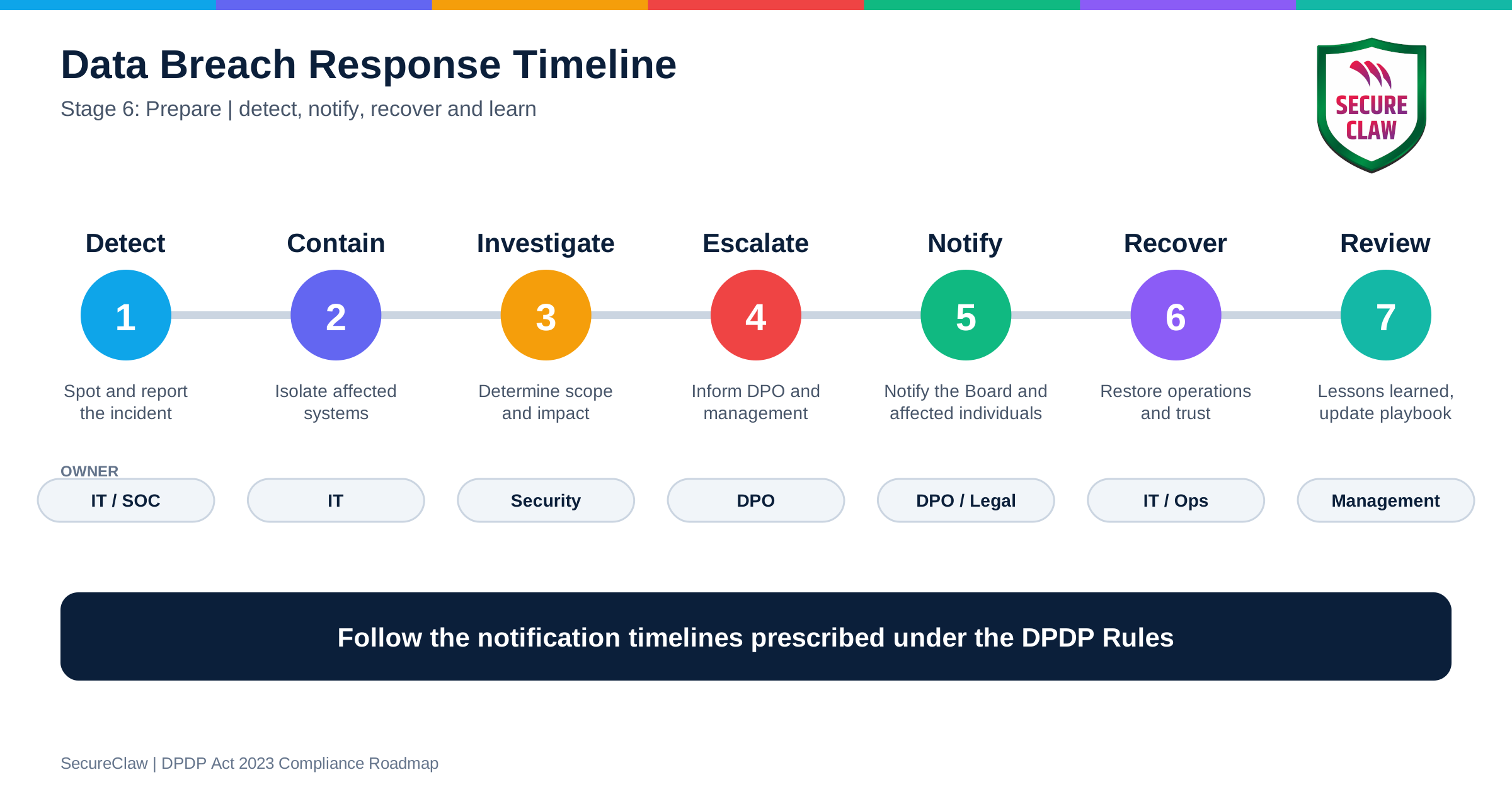
We help you establish a Data Breach Management Framework covering:
- Detection: how incidents are spotted and reported
- Investigation: how scope and impact are determined
- Escalation: who is informed and when
- Notification: how affected individuals and the regulator are informed
- Recovery: how operations and trust are restored
Then we test it. Tabletop exercises and breach simulations reveal weaknesses in your plan before a real incident does.
Deliverables
- Employee Training Program, Awareness Materials and Training Records
- Executive Briefing Report
- Incident Response Playbook
- Breach Readiness Report
Stage 7: Monitor (Audit, Reporting and Continuous Compliance)
Compliance is a continuing practice, not a one-time project.
New applications, new vendors, new employees, new threats and new regulations all change your risk. The Monitor stage keeps your compliance current.
What it includes
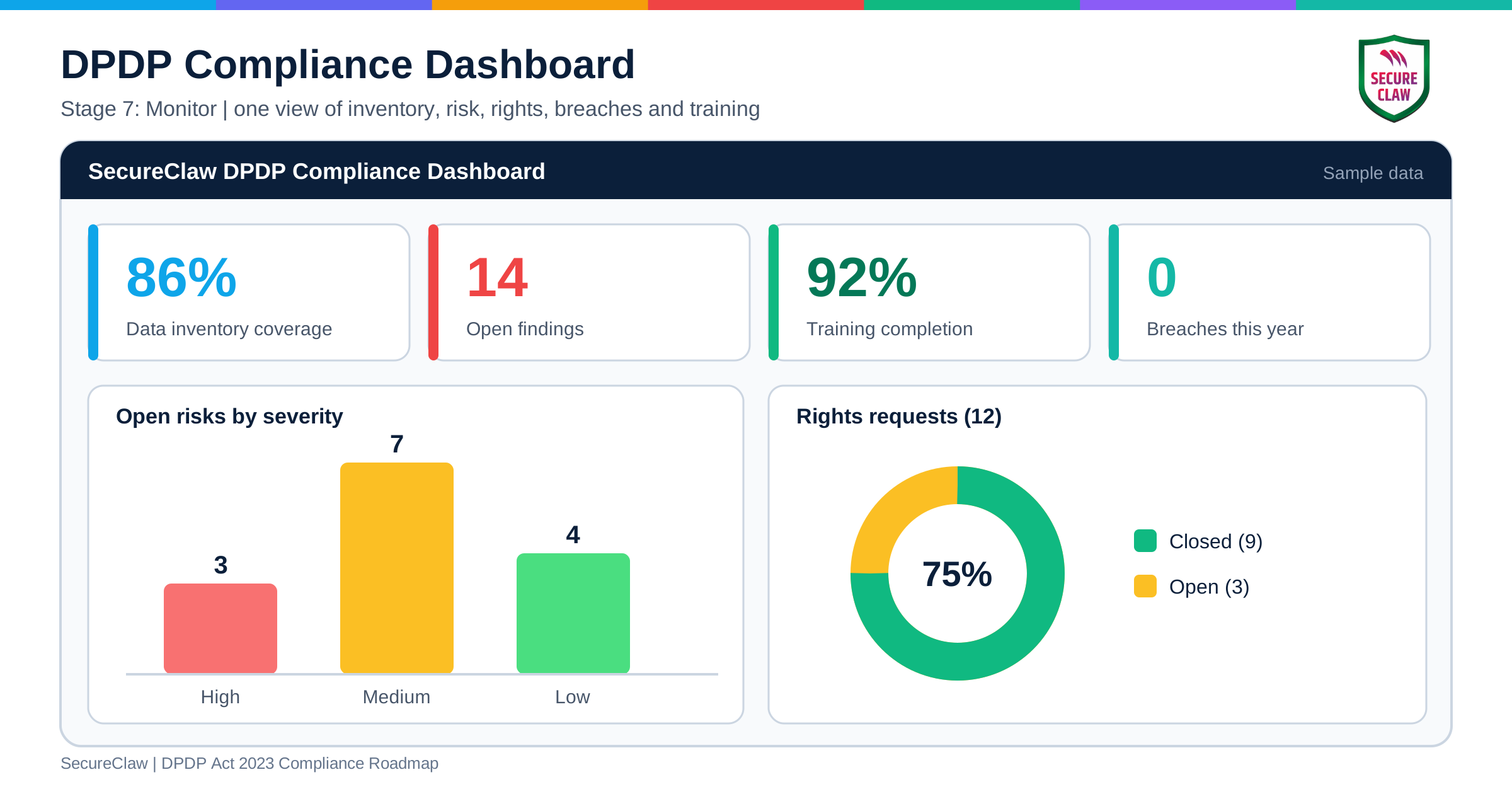
- Compliance reporting. Executive dashboards track data inventory status, risk status, open findings, data breaches and rights requests.
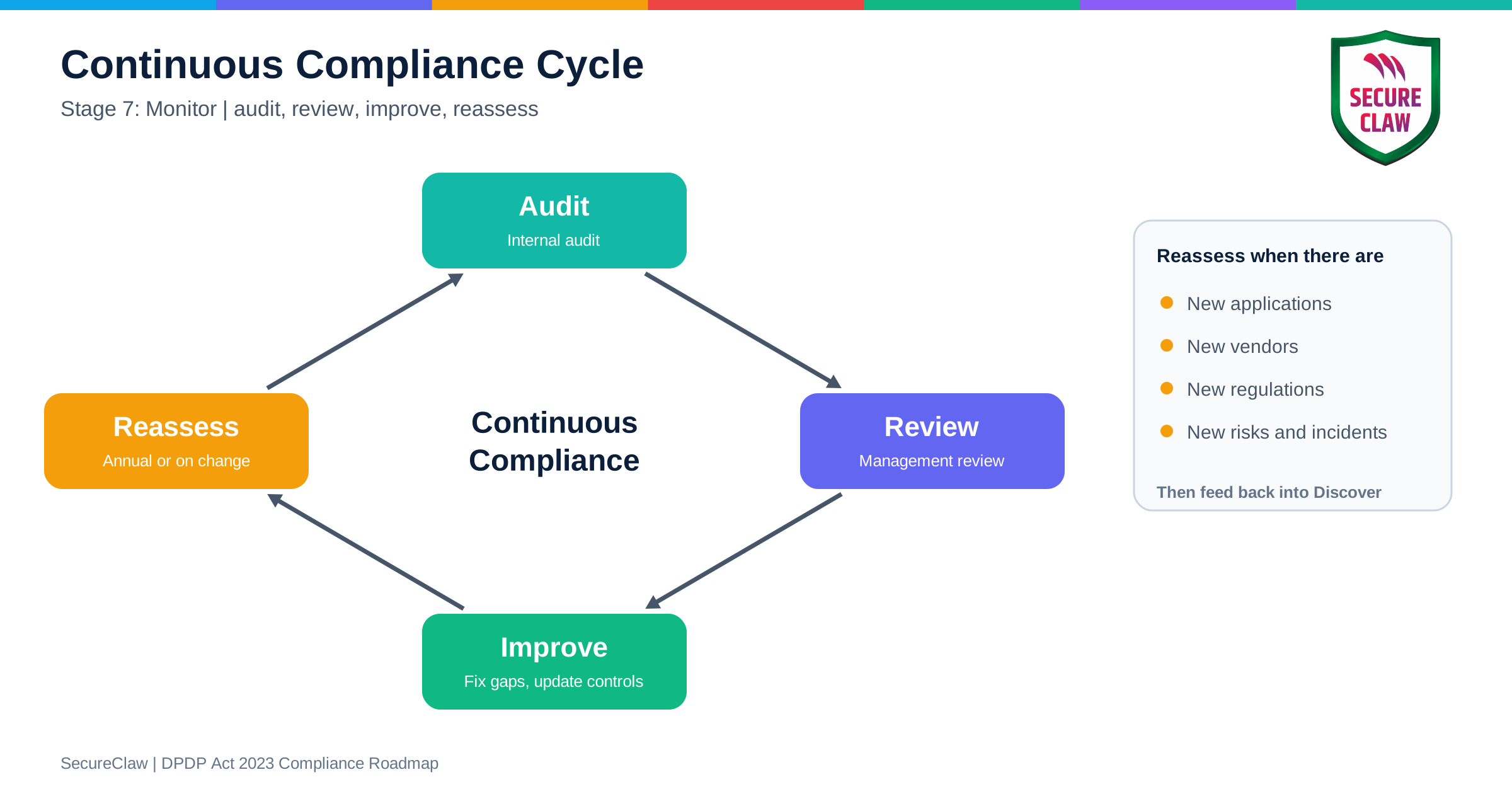
- Internal audit. We validate that policies are followed, controls operate effectively and risks are addressed.
- Management review. Leadership reviews compliance status, open risks and improvements required.
- Periodic reassessment. At least annually, and whenever major changes occur, we review new applications, vendors, regulations and risks.
- Continuous monitoring and improvement. Track security incidents, newly discovered vulnerabilities, new personal data processing activities and regulatory changes.
Deliverables
- DPDP Compliance Dashboard
- Internal Audit Report
- Management Review Minutes
- Annual Compliance Review
- Continuous Improvement Program
Built for MSMEs, Trusted by Enterprises
Many compliance frameworks are expensive and designed for large enterprises. SecureClaw's methodology is designed to be:
What it includes
- Practical: focused on what your business actually needs
- Cost-effective: right-sized for small and mid-sized organizations
- Scalable: grows as your data and operations grow
- Business-friendly: clear language, clear priorities
- Cybersecurity-driven: privacy backed by real technical safeguards
Why choose SecureClaw?
Traditional compliance consultants focus on paperwork. Security firms focus on technology. SecureClaw combines cybersecurity expertise, privacy governance, risk management and compliance implementation in one integrated approach, tailored to Indian MSMEs, startups, enterprises, supply chain organizations and technology service providers.
| Benefit | What it means for you |
|---|---|
| Regulatory Readiness | Be prepared for evolving DPDP requirements |
| Reduced Cybersecurity Risk | Stronger controls protecting personal data |
| Stronger Customer Trust | Demonstrate responsible data handling |
| Better Governance | Clear processes, roles and accountability |
| Competitive Differentiation | Use privacy and security as business enablers |
Frequently Asked Questions (FAQ)
- Does the DPDP Act apply to small businesses?: Yes, it can. The Act focuses on whether you process digital personal data, not on how large you are. Even a 10-person organization with customer or employee data may be covered.
- Is DPDP compliance only a legal task?: No. The Act requires reasonable security safeguards, so cybersecurity controls such as VAPT, encryption, MFA and monitoring are an essential part of compliance.
- How long does the journey take?: Timelines depend on organization size, number of systems and vendors, and current maturity. A readiness assessment is the best way to scope this properly.
- Do we need to do this every year?: Compliance is continuous. We recommend an annual reassessment, plus a review whenever you add major applications, vendors or data processing activities, or when regulations change.
Note: The DPDP Rules and their implementation timelines are being phased in. SecureClaw tracks regulatory updates so that your program stays aligned with the latest requirements.
Start Your DPDP Compliance Journey Today
The real question is no longer whether your organization should prepare for data privacy compliance. It is this:
"If a data breach occurs tomorrow, can your organization demonstrate that adequate privacy and cybersecurity controls were in place?"
SecureClaw helps you answer that question with confidence.
Book Your DPDP Readiness Assessment with SecureClaw Today.
Assess. Protect. Comply. Grow!